
Fontaine Desaix
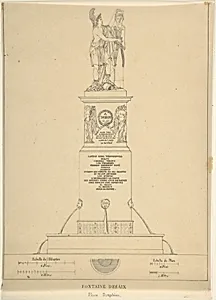
Medium
Pen and black ink on tracing paper
Dimensions
9 13/16 x 7 1/16 in. (25 x 17.9 cm.)
Classification
Drawings
Department
Drawings and Prints
Museum
Metropolitan Museum of Art, New York, NY
Credit
The Elisha Whittelsey Collection, The Elisha Whittelsey Fund, 1966
Accession Number
66.559.26
Rights
Public Domain
Tags
Art Historical Context
Nestled in the Metropolitan Museum of Art's Drawings and Prints department, *Fontaine Desaix* is a delicate preparatory sketch by the renowned French architectural duo Charles Percier (1764–1838) and Pierre-François-Léonard Fontaine (1762–1853). Rendered in pen and black ink on tracing paper, this 9 13/16 x 7 1/16-inch drawing captures the design of a monumental fountain honoring General Louis Charles Antoine Desaix, a hero of Napoleon's Egyptian campaign who fell at the Battle of Marengo in 1800. The tags—Monuments, Heads, Men—hint at its focus on a stately bust or portrait head atop the structure, evoking imperial grandeur. Percier and Fontaine, close collaborators and official architects to Napoleon Bonaparte, epitomized the Neoclassical Empire style, blending Roman severity with revolutionary fervor. Their work adorned palaces and public spaces, symbolizing France's newfound imperial might. This tracing paper sketch, a practical tool for refining designs through overlays, underscores their meticulous process in crafting enduring public monuments that celebrated military glory and national pride. Though the date remains unknown, *Fontaine Desaix* reflects early 19th-century Paris's transformative urban renewal under Napoleon, where fountains like this one (erected around 1810 near Place Dauphine) served as civic focal points. Acquired through The Elisha Whittelsey Fund in 1966, it offers visitors a glimpse into the blueprint of history, where ink lines sketched the contours of empire.
About the Artist
Charles Percier|Pierre François Léonard Fontaine · 1764–1838
Charles Percier (1764–1838) rose from humble origins in Paris, where his mother laundered for Marie-Antoinette and his father served as a porter at the Tuileries Palace, to become one of France's most influential neoclassical architects and designers. From age twelve, he attended a free drawing school for indigent students, honing his skills in the studio of painter Louis-Jean-François Lagrenée be...