
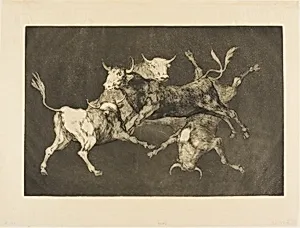
Fool’s Folly, from Disparates
1816–19, published 1877
Medium
Etching and burnished aquatint in black on Japanese paper
Dimensions
Image: 21.2 × 32.4 cm (8 3/8 × 12 13/16 in.); Plate: 24.5 × 34.5 cm (9 11/16 × 13 5/8 in.); Sheet: 28.3 × 37.5 cm (11 3/16 × 14 13/16 in.)
Classification
etching
Department
Prints and Drawings
Museum
Art Institute of Chicago
Accession Number
27159
Rights
Public Domain
About this artwork
In this ludicrous vision, bulls tumble effortlessly in the air, completely unfazed by the fact that they are bobbing like balloons. This print is from an enigmatic series that Goya began in his late 70s but never finished before moving to France. Titled Disparates, which roughly translates to nonsense, absurdity, or fantasy, the series would have included at least 25 images, but only 22 plates are known to exist. Fool’s Folly is one of four plates that were separated from the 18 printed posthumo...
Art Historical Context
**Fool’s Folly, from *Disparates*** Francisco Goya y Lucientes (1746–1828) Created between 1816 and 1819 but not published until 1877 *Fool’s Folly* is one of 22 enigmatic prints from Goya’s *Disparates* seriesalso known as *Proverbios*). In his late years, the Spanish master—deaf, isolated, and deeply disillusioned by war, political upheaval, and human folly—poured his darkest visions into these works. Unlike his earlier satirical *Los Caprichos*, the *Disparates* plunge into surreal, nightmarish absurdity, critiquing society’s madness through shadowy, dreamlike scenes that evoke proverbs of folly and vice. Goya’s innovative etching and burnished aquatint technique shines here, rendered in stark black on luxurious Japanese paper. Aquatint allows velvety tonal depths, while burnishing scrapes away ink for luminous highlights, heightening the eerie drama. This print exemplifies Goya’s Romantic pivot toward the psychological and grotesque, influencing later modernists like Picasso and the Surrealists. A testament to his fearless genius, it invites visitors to ponder the timeless follies of humankind. *(Art Institute of Chicago, Prints and Drawings Department)* (178 words)
About the Artist
Francisco José de Goya y Lucientes · 1746–1828
Francisco José de Goya y Lucientes was born on March 30, 1746, in the small Aragonese village of Fuendetodos, Spain, to José Benito de Goya, a master gilder, and Gracia de Lucientes. The fourth of six children in a modest lower-middle-class family, Goya received a basic education before beginning his artistic training at age 14 under the local painter José Luzán y Martínez in Zaragoza, where he sp...