
Foot Combat with Halberds
c.1512-1515
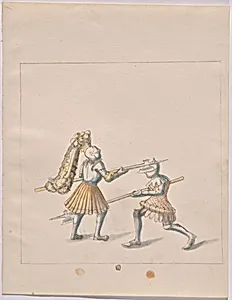
Medium
pen and black ink with watercolor over black chalk and corrected with white gouahce on laid paper
Dimensions
sheet: 33.8 × 26.1 cm (13 5/16 × 10 1/4 in.)
Classification
Drawing
Department
CG-E
Museum
National Gallery of Art, Washington, D.C.
Credit
Rosenwald Collection
Accession Number
1943.3.4546
Rights
Public Domain
Art Historical Context
"Foot Combat with Halber," created by an anonymous German artist around 1512-1515, captures the raw intensity of Renaissance-era warfare. This dynamic drawing depicts two armored figures locked in fierce hand-to-hand combat using halds—versatile pole weapons favored by infantry during the early 16th century Emerging from Germany's turbulent Holy Roman Empire, where mercenary armies like the Landsknechts dominated battlefields, the scene reflects the period's military innovations amid the Italian Wars and rising use of pike formations. Executed on laid paper with black chalk underdrawing, the work employs pen and black ink for precise contours, layered with watercolor for vivid highlights, and corrected with white gouache for refined details. This mixed-media technique, common in Northern Renaissance drawings, allowed artists to explore movement and anatomy with fluid spontaneity, often as studies for prints or paintings. At 33.8 × 26.1 cm, its intimate scale invites close viewing, revealing the meticulous corrections that underscore the artist's commitment to realism. Housed in the National Gallery of Art's Rosenwald Collection (Department CG-E), this classified drawing exemplifies the technical prowess of early German draftsmen, bridging Gothic traditions and emerging Renaissance naturalism. It offers visitors a window into the human drama of combat, blending historical grit with artistic innovation.
About the Artist
German 16th Century · 1500–1600
The designation "German 16th Century" refers to a collective of anonymous artists active during the height of the German Renaissance, a period marked by profound artistic innovation amid the Protestant Reformation and humanist revival. Little is known about the individual lives or training of these makers, as their identities remain undocumented, with works often attributed based on regional style...