
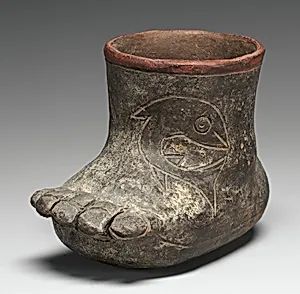
Foot Jar
Unknown Artist
2nd–1st century BCE
Medium
Ceramic, slip
Dimensions
H. 2 3/8 × W. 3 1/4 × D. 2 in. (6 × 8.3 × 5.1 cm)
Classification
Ceramics-Containers
Culture
Paracas
Department
Arts of Africa, Oceania, and the Americas
Museum
Metropolitan Museum of Art, New York, NY
Credit
Gift of Nathan Cummings, 1963
Accession Number
63.232.69
Rights
Public Domain
Tags
Art Historical Context
This charming ceramic vessel, known as the Foot Jar, dates to the 2nd1st century BCE and from the Paracas of ancient Peru. Measuring just over two inches high, the small container takes the distinctive form of a human foot, its rounded contours and subtle modeling achieved through skilled hand-building techniques. The use of slip—a liquid clay mixture—allowed artisans to add decorative elements, including fish motifs that appear alongside the foot shape, suggesting a playful or symbolic interplay between human and natural forms. Housed in the Metropolitan Museum of Art’s collection of Arts of Africa, Oceania, and the Americas, this piece exemplifies the inventive ceramic traditions of the Paracas people. Such foot-shaped containers may have served practical purposes while carrying deeper cultural meanings, perhaps linking the body to themes of movement, fertility, or the sea. Its compact scale and lively details invite viewers to appreciate the creativity of anonymous Paracas potters who transformed everyday materials into objects of both utility and wonder.