
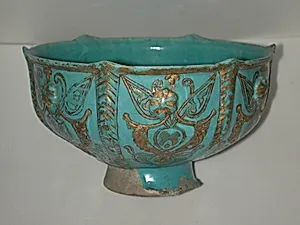
Footed Bowl
Unknown Artist
late 12th–first half 13th century
Medium
Stonepaste; molded decoration; overglaze painted and gilded on a monochrome opaque glaze (mina'i)
Dimensions
H. 4 1/2 in. (11.4 cm) Diam. 7 7/8 in. (20 cm) Wt. 21.2 oz. (601.1 g)
Classification
Ceramics
Department
Islamic Art
Museum
Metropolitan Museum of Art, New York, NY
Credit
Rogers Fund, 1912
Accession Number
12.224.1
Rights
Public Domain
Art Historical Context
This elegant footed bowl, crafted by an unknown artist in the late 12th to first half of the 13th century, exemplifies the pinnacle of Islamic ceramic artistry. Housed in the Metropolitan Museum of Art's Islamic Art department (acquired through the Rogers Fund in 1912), it measures 4½ inches high and nearly 8 inches in diameter, with a substantial weight of 21.2 ounces—ideal for both display and practical use at the table. Made from stonepaste, a fine-bodied material prized for its durability and ability to mimic porcelain, the bowl features molded decoration enhanced by the rare mina'i technique. This innovative process involved applying overglaze paints and gilding over a monochrome opaque glaze, then firing at low temperatures to achieve vibrant colors and shimmering gold details. Mina'i ware, produced during a golden age of Persian ceramics, represented luxury craftsmanship, often reserved for elite patrons. In the medieval Islamic world, such vessels bridged utility and opulence, reflecting cultural sophistication and technical mastery. Though its motifs remain unpreserved in our records, this bowl invites visitors to appreciate the era's fusion of form, function, and fleeting luster.