
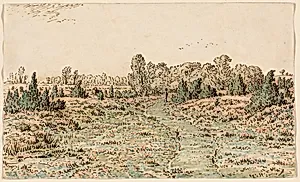
Footpath in the Barbizonnières
Medium
Pen and brown and black ink, with watercolor, over graphite, on ivory wove paper
Dimensions
12.3 × 20.4 cm (4 7/8 × 8 1/16 in.)
Classification
prints and drawing
Department
Prints and Drawings
Museum
Art Institute of Chicago
Accession Number
193872
Rights
Public Domain
Art Historical Context
Step into the tranquil world of Théodore Rousseau's *Footpath in the Barbnières* (1864), a gem from the Art Institute of Chicago's Prints Drawings collection. Rousseau, a pioneering leader of the Barbizon school, devoted his life to capturing the unvarnished beauty of France's Fontainebleau Forest near the village of Barbizonhence the title's nod to "Barbizonnières," the surrounding wooded paths. This intimate landscape reflects the school's revolutionary ethos: painting en plein air, directly from nature, rejecting the polished studios of academic art. Crafted on ivory wove paper (just 12.3 × 20.4 cm), the work blends graphite underdrawing with pen in brown and black inks, heightened by watercolor. This mixed-media technique allowed Rousseau to evoke the dappled light filtering through trees, the earthy texture of a forest path, and subtle atmospheric depth—hallmarks of his meticulous realism. Far from a grand canvas, its small scale suggests a personal study, cherished by the artist who often labored outdoors for authenticity. Rousseau's vision bridged Romanticism and Impressionism, influencing later masters like Monet. Created late in his career, this piece embodies his fierce commitment to nature's raw poetry, inviting visitors to pause and savor the quiet magic of a woodland stroll.
About the Artist
Théodore Rousseau · 1812–1867
Théodore Rousseau (1812–1867) was a French landscape painter and the leading figure of the Barbizon School, the group of artists who settled in the village of Barbizon near the Forest of Fontainebleau to paint directly from nature. Born in Paris, he showed precocious talent and studied under the academic painters Charles Rémond and Guillaume Guillon-Lethière, but quickly rejected classical landsca...