
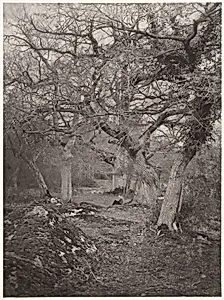
Forêt de Fontainebleau
1870s
Medium
Carbon print from glass negative
Dimensions
Image: 18.8 x 13.9 cm (7 3/8 x 5 1/2 in.) Mount: 28.1 x 20.6 cm (11 1/16 x 8 1/8 in.)
Classification
Photographs
Department
Photographs
Museum
Metropolitan Museum of Art, New York, NY
Credit
Gift of Alain Paviot, in memory of Samuel J. Wagstaff Jr., 1987
Accession Number
1987.1146
Rights
Public Domain
Tags
Art Historical Context
Step into the serene depths of *Forêt de Fontaineble*, a captivating carbon print by William Harrison from the 1870s. This intimate landscape, measuring 18.8 x 13.9 cm, captures the lush, dappled woodlands of France's Fontainebleau Forest—a beloved haunt for artists seeking nature's raw beauty. Harrison, a photographer of the era, transports us to this iconic site, where towering trees and tangled undergrowth evoke a sense of timeless wilderness. In the 1870s, was evolving rapidly, and Harrison's choice of carbon print from a glass negative exemplifies technical innovation. Developed in the mid-19th century, this process used pigments in a gelatin emulsion to produce richly toned, fade-resistant images, ideal for preserving delicate landscapes. Fontainebleau, long a muse for the Barbizon painters like Corot and Millet, now found new life through the lens, bridging painting and photography during a pivotal shift toward realism in art. Today, housed in the Metropolitan Museum of Art as a gift from Alain Paviot in memory of Samuel J. Wagstaff Jr., this print highlights photography's role in democratizing nature's grandeur. Visitors can appreciate how Harrison's steady gaze on forests and trees not only documents but also romanticizes the natural world, inviting quiet reflection amid the bustle of modern life.