
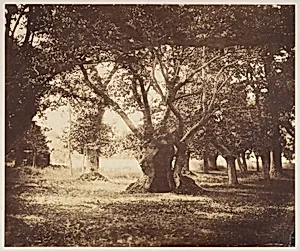
Hollow Oak Tree, Fontainebleau
1855–57
Medium
Albumen silver print from glass negative
Dimensions
Image: 12 3/8 × 14 13/16 in. (31.5 × 37.7 cm) Sheet: 12 3/8 × 14 13/16 in. (31.5 × 37.7 cm) Mount: 20 3/8 in. × 27 7/16 in. (51.8 × 69.7 cm)
Classification
Photographs
Department
Photographs
Museum
Metropolitan Museum of Art, New York, NY
Credit
Bequest of Maurice B. Sendak, 2012
Accession Number
2013.159.38
Rights
Public Domain
Tags
Art Historical Context
Step into the ancient heart of Fontainebleau Forest with Gustave Le Gray's *H Oak Tree, Fontaineble* (1855–57), a masterful albumen silver print that the majestic decay of a venerable oak. Le Gray, a pioneering French and teacher at the École des Be-Arts, revered the forest's rugged beauty—a haunt for artists of the Barbizon school, who sought inspiration in nature's unvarnished grandeur. This image, with its dramatically twisted trunk and shadowed hollow, evokes the Romantic sublime, transforming a single tree into a monument of endurance and time. Printed from a glass negative, the work showcases Le Gray's technical innovations. Albumen silver prints, coated with egg whites for exceptional clarity and warm tones, were the gold standard of mid-19th-century photography. His large-format negative (31.5 × 37.7 cm) yields intricate details—from bark textures to dappled light—rivaling painting's fidelity while pioneering photography as fine art. Housed in the Metropolitan Museum of Art through the bequest of Maurice B. Sendak, this print bridges eras: a testament to Le Gray's influence on landscape photography and Fontainebleau's enduring cultural allure as a cradle of artistic naturalism. Gaze upon it, and feel the whisper of centuries-old oaks.
About the Artist
Gustave Le Gray · 1820–1884
Gustave Le Gray, born on August 30, 1820, in Villiers-le-Bel near Paris to a prosperous merchant family, pursued his artistic ambitions against his parents' wishes for a legal career. As an only child, he trained as a painter in the studios of François-Édouard Picot and Paul Delaroche at the École des Beaux-Arts, exhibiting at the Paris Salons in 1848 and 1853. In 1844, he married Palmira Leonardi...