
Fork
ca. 1750–60
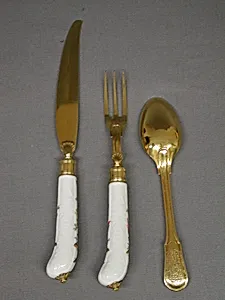
Medium
Hard-paste porcelain, silver gilt
Dimensions
Length: 7 1/2 in. (19.1 cm)
Classification
Ceramics-Porcelain
Culture
German, Meissen
Department
European Sculpture and Decorative Arts
Museum
Metropolitan Museum of Art, New York, NY
Credit
Gift of Mr. and Mrs. Charles Wrightsman, 1976
Accession Number
1976.155.94
Rights
Public Domain
Art Historical Context
Step into the opulent world of 18th-century European dining this elegant fork from the Meissen Manactory, crafted around 1750–60. Made of hard-paste porcelain with silver gilt accents, it measures a graceful 7½ inches long, blending functionality with exquisite artistry. Meissen, the pioneering German porcelain factory founded in 1710 near Dresden, was Europe's first to master the secret of true hard-paste—a durable, translucent material long monopolized by China—elevating ceramics to the level of fine art. During the Rococo era, Meissen pieces like this fork embodied lavish luxury for aristocratic tables. The porcelain's fine white body, often hand-painted with intricate motifs and gilded for shimmer, showcased the manufactory's technical virtuosity and playful, asymmetrical designs. Forks were emerging as essential utensils in refined European etiquette, and rendering one in fragile porcelain underscored the era's delight in delicate extravagance—a status symbol for the elite. Gifted to the Metropolitan Museum of Art by Mr. and Mrs. Charles Wrightsman in 1976, this fork invites us to imagine candlelit banquets where every utensil sparkled like jewelry. It highlights how Meissen's innovations not only democratized porcelain but also enriched cultural rituals of hospitality and display.
About the Artist
Meissen Manufactory · 1710–present
The Meissen Manufactory, established on June 6, 1710, by Augustus the Strong, Elector of Saxony and King of Poland, marked the dawn of true hard-paste porcelain production in Europe. Nestled at Albrechtsburg Castle in Meissen near Dresden, the Royal Polish and Electoral Saxon Porcelain Manufactory arose from alchemical experiments begun in 1708 by physicist Ehrenfried Walther von Tschirnhaus and p...