
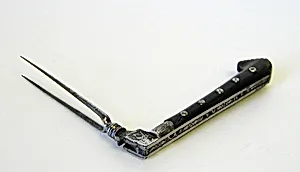
Fork from Folding Cutlery Set
1680–1720
Medium
cutlery
Classification
cutlery
Department
Smithsonian Collection
Museum
Smithsonian American Art Museum
Credit
The Robert L. Metzenberg Collection, gift of Eleanor L. Metzenberg
Accession Number
1985-103-140
Rights
Public Domain
About this artwork
Research in Progress
Art Historical Context
This elegant fork hails from a rare folding cutlery set, crafted between 1680 and 1720 during the late Colonial American period. As part of the Smithsonian American Art Museum's collection—generously gifted from The Robert L. Metzenberg by Eleanor L. Metberg—it exemplifies the practical artistry of early American metalwork. With its unknown maker, the piece highlights the anonymous skilled artisans who produced everyday objects blending utility and subtle refinement. Folding cutlery like this a traveler's essential in an era before standardized table settings, allowing knives, spoons, and forks to nest compactly for portability on long journeys, at sea, or in frontier homes. Made likely from silver or base metals common to the time, it reflects the craftsmanship of silversmiths influenced by European traditions adapted to New World needs, showcasing hinged mechanisms that demonstrate ingenious engineering for daily life. Though research continues on this intriguing artifact, it offers a window into 17th- and 18th-century domestic culture, where such sets symbolized status and preparedness amid colonial expansion. A testament to functional design, it invites us to appreciate the artistry hidden in the tools of history.
About the Artist
Unknown
The artist designated as "Unknown" in our virtual museum's collection exemplifies a poignant chapter in art history: creators whose identities have faded into obscurity despite the enduring power of their work. With only one known artwork attributed to them in our holdings, this figure represents countless anonymous hands that shaped visual culture across centuries. Museums worldwide, including th...