
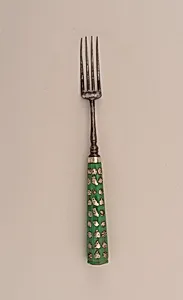
Fork with Green-stained Ivory and Silver Applieque Handle
1750–1800
Classification
cutlery
Department
Smithsonian Collection
Museum
Smithsonian American Art Museum
Credit
The Robert L. Metzenberg Collection, gift of Eleanor L. Metzenberg
Accession Number
1985-103-130
Rights
Public Domain
About this artwork
Research in Progress
Art Historical Context
This elegant fork, dating from 1750–1800, exemplifies the craftsmanship of late colonial and early American decorative arts. Featuring a handle of green-stained ivory adorned with silver appliqué, it transforms everyday cutlery into a luxurious object. Ivory, prized for its smooth texture and workability, was often stained for vibrant color effects, while silver accents added a touch of opulence, suggesting this piece belonged to an affluent household. In the context of 18th-century America, tableware highlighted growing colonial sophistication and trade connections, importing exotic materials like ivory alongside local silversmithing traditions. Forks were gaining popularity as dining etiquette evolved, symbolizing status at the table. Though the exact medium details and maker remain under study—marked as "Research in Progress"—its presence in the Smithsonian American Art Museum underscores its value as a snapshot of everyday luxury. Part of The Robert L. Metzenberg Collection, generously gifted by Eleanor L. Metzenberg, this fork invites us to ponder the artistry in the intimate tools of daily life, bridging utility and beauty in early American material culture.
About the Artist
Unknown
The artist designated as "Unknown" in our virtual museum's collection exemplifies a poignant chapter in art history: creators whose identities have faded into obscurity despite the enduring power of their work. With only one known artwork attributed to them in our holdings, this figure represents countless anonymous hands that shaped visual culture across centuries. Museums worldwide, including th...