
Forsyth Patent Second Model Sliding Primer Over-and-Under Pistol with Case and Accessories
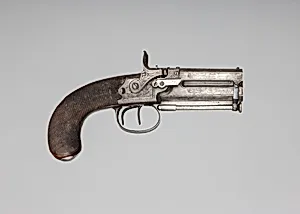
Medium
Pistol: steel, wood (walnut), silver; case: wood (mahogany), brass, textile, ivory; flask: ivory; oil can: steel; cleaning rod: brass, steel
Dimensions
Pistol (a): L. 9 in. (22.9 cm); L. of barrels 4 1/16 in. (10.3 cm); Cal. of barrels .54 in. (1.4 cm); Wt. 1 lb. 12 oz. (793.8 g); flask (b): L. 3 1/8 in. (7.9 cm); Wt. 0.5 oz. (14.2 g); oil can (c); H. 5/8 in. (1.6 cm); Wt. 1.6 oz. (45.4 g); cleaning rod (d): L. 6 3/16 in. (15.7 cm); Wt. 3.1 oz. (87.9 g); case (e): H. 2 5/8 in. (6.7 cm); W. 11 5/8 in. (29.5 cm); D. 6 3/4 in. (17.1 cm); Wt. 2 lb. 10.3 oz. (1199.2 g)
Classification
Firearms-Pistols
Culture
British, London
Department
Arms and Armor
Museum
Metropolitan Museum of Art, New York, NY
Credit
Gift of Charles M. Schott Jr., 1917
Accession Number
19.53.104a–e
Rights
Public Domain
Art Historical Context
Step into the Arms and Armor to admire the Forsyth Patent Second Model Sliding Primer-and-Under Pistol, around 1824 by Alexander John Forsyth and his London firm. This elegant double-barreled flintlock pistol, with its superimposed barrels measuring just over 4 inches long, a pinnacle of early 19th-century Britishmithing. Housed in a fitted mahogany case alongside ivory powder flask, steel oil can, and brass cleaning rod, the ensemble weighs nearly 6 pounds total, showcasing the era's blend of functionality and luxury. Forsyth, a Scottish clergyman-inventor, revolutionized firearms with his 1807 patent for the detonating primer—a volatile slid into place to ignite powder, bridging flintlocks and modern percussion caps. This second-model iteration improved reliability for hunters and officers, reducing misfires in damp conditions. Its .54-caliber steel barrels, silver accents, and finely figured walnut stock highlight meticulous craftsmanship, where form met deadly precision. A gift to the Metropolitan Museum of Art in 1917, this pistol isn't just a weapon but a testament to innovation during the Napoleonic aftermath, when British ingenuity propelled arms technology forward. Visitors will appreciate its compact power and the case's bespoke interior, evoking a gentleman's sporting arsenal.
About the Artist
Forsyth & Co.|Alexander John Forsyth ( |British) · 1808 |1768 –1852 |1843
British, London 1808–1852|British, 1768–1843