
Fortuin
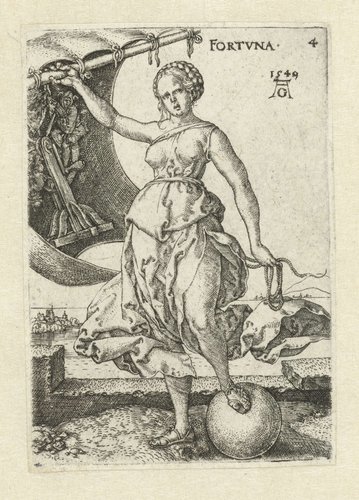
Medium
engraving
Dimensions
48; 70
Rights
Public Domain
About this artwork
height 70 mm x width 48 mm
Art Historical Context
Heinrich Aldegrever's *Fortuin* (1549) is a exquisite small-scale engraving, measuring just 70 mm high by 48 mm wide, exemplifying the mastery of the German Renaissance printmaker. Born around 1502 in Soest, Westphalia, Aldegrever was one of the "Little Masters," a group of artists renowned for their intricate engravings on a diminutive scale. Active during the Northern Renaissance, he drew inspiration from Albrecht Dürer and Italian Mannerism, producing works that blended fine detail with moral and allegorical themes. Created amid the religious upheavals of the Reformation era, *Fortuin*—likely depicting the personification of Fortune—reflects the period's fascination with fate, prosperity, and human transience. Engraving, Aldegrever's preferred medium, involved incising designs into a copper plate with a burin, inking it, and printing onto paper, allowing for precise lines and tonal effects unachievable in painting. This technique democratized art, making high-quality images affordable and portable across Europe. The artwork's tiny dimensions demanded exceptional skill, with densely packed details that reward close viewing—much like peering into a Renaissance jewel. *Fortuin* stands as a testament to Aldegrever's prolific output of over 200 engravings, which influenced goldsmiths, jewelers, and collectors. Today, it invites us to ponder timeless questions of luck and fortune in a format that captures the era's technical innovation and philosophical depth.
About the Artist
Heinrich Aldegrever · 1502–1561
Heinrich Aldegrever, born in 1502 in Paderborn, Westphalia, to parents Herman and Katherine Trippenmeker—a family of clog-makers known by the dialect name Trippenmecker—emerged as a multifaceted artist in the German Renaissance. His early training remains undocumented, though he likely apprenticed in a Soest goldsmith's workshop after relocating there around 1525, where he joined the painters' gui...