
Fortune
1632/48
Medium
Etching on cream laid paper
Dimensions
23.7 × 14.5 cm (9 3/8 × 5 3/4 in.)
Classification
etching
Department
Prints and Drawings
Museum
Art Institute of Chicago
Accession Number
42988
Rights
Public Domain
About this artwork
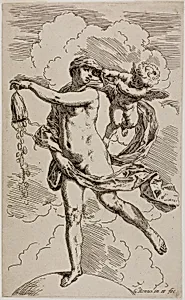
Fortune, the goddess of chance and luck, accidentally spills her coin purse out into the heavens, an act that symbolizes the goddess’s arbitrary nature. A winged putto alerts Fortune to this act of blind fate by pulling her hair back from her eyes. Cantarini likely completed this print while under the tutelage in Mantua of his mentor, Guido Reni (Italian, 1575–1642). Reni was widely known for his painting of Fortune, and several etchings, including this one, were made after its likeness. But the...
Art Historical Context
Simone Cantarini's *Fortune*, created between 1632 and1648, is a delicate etching on cream laid paper, measuring 23.7 × 14.5 cm. This intimate print, housed in the Art Institute of Chicago's Prints Drawings department, exemplifies theolognese artist's mastery during the Baroque era. Cantarini (1612–1648), a protégé of Guido Reni, blended classical elegance with dramatic flair, drawing from the Carracci legacy to produce refined, reproducible images that circulated widely across Europe. Etching allowed Cantarini to achieve fluid, expressive lines with remarkable precision—acid etching into a copper plate created intricate details in the allegorical figure of Fortune, symbolizing chance and prosperity. This medium was revolutionary in the 17th century, democratizing access to high art beyond paintings, as prints could be inked and pulled in multiples for collectors and scholars. *Fortune* captures the era's fascination with fate amid religious and political upheavals, inviting viewers to ponder life's unpredictability. Its compact scale and creamy paper enhance the luminous quality, making it a gem for print enthusiasts—a testament to Cantarini's short but brilliant career before his early death at 36.
About the Artist
Simone Cantarini · 1612–1648
He was one of the most eminent pupils of Guido Reni and one of the most gifted engravers in the tradition of the Carracci. He had a strong personality and developed a highly original style, which united aspects of Bolognese classicism with a bold naturalism. Comment on works: Religious