
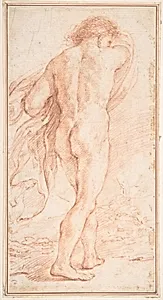
Nude Figure with Cloak, seen from rear
Medium
Red chalk on cream laid paper
Dimensions
11-5/16 x 6-3/16 in. (28.8 x 15.7 cm)
Classification
Drawings
Department
Drawings and Prints
Museum
Metropolitan Museum of Art, New York, NY
Credit
Gift of Cornelius Vanderbilt, 1880
Accession Number
80.3.15
Rights
Public Domain
Tags
Art Historical Context
This delicate drawing, *Nude Figure with Cloak, seen from Rear*,ails from 17th-century Italy, attributed to an anonymous artist of the Roman-Bolognese. Crafted in red chalk on cream laid paper it measures a modest 11-5/16 x 6-3/16 inches, capturing a male nude from behind with a flowing cloak draped over one shoulder. Such preparatory sketches were vital in the Baroque era, serving as anatomical studies for painters and sculptors honing their mastery of the human form. Red chalk, prized for its warm, fleshy tones, allowed artists to render subtle contours and soft shadows with remarkable sensitivity—evident here in the figure's poised musculature and the cloak's fluid folds. The Roman-Bolognese tradition, influenced by masters like the Carracci brothers and Guido Reni, emphasized naturalism and classical ideals, making this work a window into the rigorous life-drawing sessions of Italian academies during a time when anatomical precision fueled the grandeur of Baroque art. Now housed in the Metropolitan Museum of Art's Drawings and Prints department, it entered the collection as a gift from Cornelius Vanderbilt in 1880. This anonymous gem invites us to appreciate the unsung labor behind Italy's artistic triumphs, reminding visitors of the timeless allure of the male nude in Western art.