
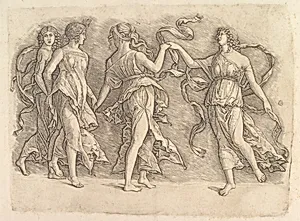
Four Dancing Muses
Medium
Engraving
Dimensions
Plate: 10 1/4 × 13 3/4 in. (26 × 35 cm) Sheet: 14 in. × 19 1/16 in. (35.5 × 48.4 cm)
Classification
Prints
Department
Drawings and Prints
Museum
Metropolitan Museum of Art, New York, NY
Credit
Rogers Fund, 1920
Accession Number
20.5.3
Rights
Public Domain
Tags
Art Historical Context
Behold *Four Dancing Muses*, captivating engraving from around 1497, created by the renowned Italian Renaissance artist Andrea Mante in collaboration with engraver Gian Marco Cavalli. Housed in the Metropolitan Museum of Art's Drawings and Prints department, this work measures an impressive plate size of 10¼ × 13¾ inches, showcasing the meticulous precision of late 15th-century printmaking. Mantegna, a master of the Paduan school, drew inspiration from classical antiquity, depicting four of the nine Muses—the divine patrons of arts and sciences—in joyful motion. Their graceful, rhythmic dance evokes the harmonious ideals of Greco-Roman mythology, revived during the Renaissance as artists like Mantegna sought to emulate ancient sculptures. Cavalli's skilled engraving translates Mantegna's design into intricate lines, capturing flowing drapery and dynamic poses with remarkable clarity and depth. This print exemplifies the revolutionary role of engravings in democratizing art: unlike paintings, it could be reproduced and shared widely across Europe, spreading Renaissance humanism and classical motifs. Acquired through the Rogers Fund in 1920, it remains a testament to the era's blend of innovation, mythology, and technical virtuosity—inviting visitors to ponder the muses' eternal dance.
About the Artist
Andrea Mantegna|Gian Marco Cavalli · 1431–1506
Andrea Mantegna was born around 1431 near Padua, in the Venetian Republic, the son of a carpenter. At approximately age eleven he was taken into the workshop of the Paduan painter and antiquities collector Francesco Squarcione, who enrolled him as a guild member and immersed him in the study of Roman sculpture and classical Latin. Though Mantegna later claimed that Squarcione had exploited his lab...