
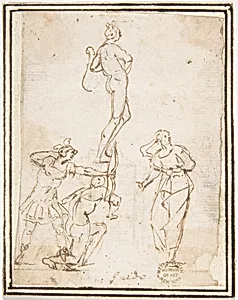
Four Figures Studies, One of a Standing Archer
1624–63
Medium
Pen and brown ink. Framing lines in pen and brown ink on mount
Dimensions
4-5/8 x 3-5/16 in. (11.7 x 8.4 cm)
Classification
Drawings
Department
Drawings and Prints
Museum
Metropolitan Museum of Art, New York, NY
Credit
Gift of Cornelius Vanderbilt, 1880
Accession Number
80.3.287
Rights
Public Domain
Tags
Art Historical Context
Nestled in the Metropolitan Museum of Art's Drawings and Prints collection, *Four Figures Studies, One of a Standing Archer* Francesco Allegrini (. 1615–1679) captures artist's keen eye for the human form during his active years from 1624 to 1663. This intimate sheet, measuring just 4-5/8 x 3-5/16 inches, showcases four dynamic figure sketches executed in pen and brown ink, with delicate framing lines on its mount. A gift from Cornelius Vanderbilt in 1880 it exemplifies the Baroque era's emphasis on anatomical precision and expressive movement. Allegrini, a Roman artist from Gubbio influenced by Caravaggesque naturalism, specialized in history paintings and genre scenes. These studies likely served as preparatory exercises, honing his ability to render musculature and pose—note the poised standing archer, bow drawn in tension. Pen and brown ink was a favored medium for such rapid, fluid sketches, allowing artists to explore light, shadow, and contrapposto with economical strokes, bridging Renaissance draftsmanship and the dramatic flair of the 17th century. This modest yet masterful drawing invites us to appreciate the groundwork of grand Baroque compositions, revealing how everyday practice fueled artistic innovation. A window into Allegrini's studio world, it reminds visitors of drawing's timeless role in capturing life's vitality.
About the Artist
Francesco Allegrini · 1615–1679
Francesco Allegrini (c. 1615/20–after 1679), born likely in Rome to the painter Flaminio Allegrini from Cantiano near Gubbio, emerged from a family of artists that included his sister, Anna Angelica Allegrini. He trained under Giuseppe Cesari, known as the Cavalier d’Arpino, around 1638–40, before entering the studio of Pietro da Cortona, whose dynamic Baroque style profoundly shaped his own. Elec...