
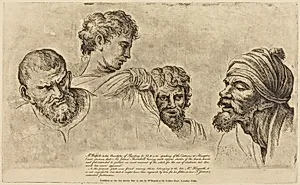
Four Heads from the Raphael Cartoons at Hampton Court
c. 1729
Medium
etching
Dimensions
sheet: 28.4 × 41.3 cm (11 3/16 × 16 1/4 in.)
Classification
Department
CG-E
Museum
National Gallery of Art, Washington, D.C.
Credit
Gift of Addie Burr Clark
Accession Number
1946.9.80
Rights
Public Domain
Art Historical Context
In the National Gallery of Art's collection, William Hogarth's *Four Heads from the Raphael Cons at Hampton Court* (c. 1729) captures the expressive faces from Raphael's monumental tapestry designs, originally created in the early 16th century for Sistine Chapel. These seven massive cartoons—full-scale preparatory drawings—were acquired by King Charles I in 1623 and housed at Hampton Court Palace, prized treasures of British royal art. Hogarth, a pioneering English artist known for his satirical engravings and moralistic scenes, produced this etching as a faithful reproductive print, making Renaissance masterpieces accessible to a wider 18th-century audience through affordable prints. Etching, Hogarth's chosen medium here, allowed for intricate line work and tonal depth on a modest sheet (28.4 × 41.3 cm). By isolating these four heads—likely from figures like Christ, the Virgin, or apostles—Hogarth highlighted Raphael's mastery of idealized anatomy, emotion, and Renaissance humanism. This work reflects the era's growing print culture, bridging Italian High Renaissance grandeur with Britain's burgeoning artistic scene, where Hogarth himself championed British art against foreign imports. A gift to the NGA from Addie Burr Clark, this print exemplifies how reproductive techniques democratized high art, inviting visitors to ponder the timeless power of Raphael's expressions through Hogarth's skilled hand.
About the Artist
William Hogarth · 1697–1764
William Hogarth (1697-1764) was an English painter, printmaker, and pictorial satirist who became the first great English-born artist to attract admiration abroad. Born into poverty in London, the son of a failed schoolmaster who was imprisoned for debt, Hogarth's early experiences with the harsh realities of 18th-century urban life profoundly shaped his artistic vision. After apprenticing with si...