
Four Schooners
Classification
seascapes
Department
Smithsonian Collection
Museum
Smithsonian American Art Museum
Credit
Gift of Charles Savage Homer, Jr.
Accession Number
1912-12-7
Rights
Public Domain
About this artwork
Research in Progress
Art Historical Context
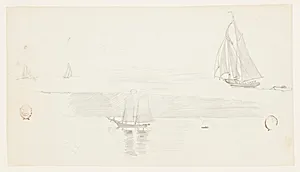
Winslow Homer (1836–1910), one of America's foremost realist painters, captured the raw power and beauty of the sea in works like *Four Schooners* (ca. 1880). By the 1880s, Homer had shifted from Civil War illustrations and rural genre scenes to intense maritime subjects, often inspired by his life along Maine's rugged coast at Prouts Neck. Thisascape likely portrays swift schooners—traditional sailing vessels central to 19th-century American trade and fishing—navigating choppy waters, embodying the perilous yet majestic life of the sea. Homer's seascapes are celebrated for their dramatic realism, mastery of light and atmosphere, and unflinching depiction of nature's forces. Though the medium is unknown, his era's works often featured oil or watercolor, techniques he honed to convey motion, spray, and wind with remarkable immediacy. *Four Schooners* exemplifies his mature style, influenced by European trips and a deep affinity for the Atlantic, elevating everyday maritime scenes to symbols of human resilience. Now in the Smithsonian American Art Museum, gifted by Homer's nephew Charles Savage Homer, Jr., this piece reflects the era's cultural fascination with America's seafaring heritage amid industrialization. It invites visitors to ponder the vanishing world of sail-powered commerce.