
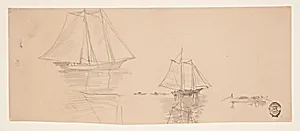
Two Schooners and Dories
Medium
seascapes
Classification
seascapes
Department
Smithsonian Collection
Museum
Smithsonian American Art Museum
Credit
Gift of Charles Savage Homer, Jr.
Accession Number
1912-12-5
Rights
Public Domain
About this artwork
Research in Progress
Art Historical Context
Winslow Homer, one of America's foremost realist painters (1836–1910), captured the raw power of the sea in *Two Schooners and Dories* (ca. 1880). This seascape depicts sturdy schooners—traditional sailing vessels—and smaller dories, likely evoking the rugged maritime life of New England's coast, where Homer spent much of his later career. By the 1880s, after travels to England and France, Homer had honed his signature style: bold, unsparing depictions of nature's drama, blending meticulous observation with emotional intensity. Homer's seascapes, often in oil or watercolor, revolutionized American art by moving beyond romanticized views to gritty realism. Here, the interplay of wind, waves, and working boats underscores human resilience against the Atlantic's might—a recurring theme in his oeuvre. Donated to the Smithsonian American Art Museum by Homer's nephew, Charles Savage Homer, Jr., this work exemplifies the artist's mastery of light and movement, inviting viewers to feel the salt spray and hear the sails snap. Though research continues, *Two Schooners and Dories* stands as a testament to Homer's enduring influence on American landscape painting, bridging 19th-century realism with modern sensibilities.