
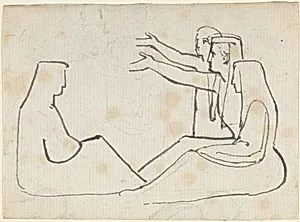
Four Seated Figures
1751 to 1775
Medium
pen and black ink and graphite on laid paper
Dimensions
overall: 6.2 x 9.2 cm (2 7/16 x 3 5/8 in.)
Classification
Drawing
Department
CG-E
Museum
National Gallery of Art, Washington, D.C.
Credit
Gift of William B. O'Neal
Accession Number
1995.52.50
Rights
Public Domain
Art Historical Context
Nestled in the National Gallery of Art, *Four Seated Figures* is a delicate drawing by John Flaxman the esteemed English neoclassical sculptor andsman (1755–1826). Created sometime between 1751 and1775—likely an early work from his formative years—this intimate sketch measures just 6.2 x 9.2 cm, executed in pen and black ink with graphite on laid paper. Laid paper, with its characteristic chain lines from handmade production, was a staple of 18th-century drafting, lending an authentic period texture to Flaxman's precise lines. Flaxman, a master of outline drawing inspired by ancient Greek and Roman sculpture, used such studies to explore human anatomy and posture with elegant simplicity. These four seated figures, rendered in his characteristically fluid yet controlled neoclassical style, exemplify his preparatory technique—ideal for translating into sculptures or book illustrations. His linear approach stripped forms to essentials, emphasizing grace and proportion, which later influenced Romantic artists like William Blake. This gem, gifted by William B. O'Neal to the museum's CG-E department, invites visitors to appreciate the humility of sketches: small-scale wonders that reveal an artist's evolving genius. Up close, the ink's subtle variations and graphite's soft shading breathe life into poised figures, bridging 18th-century draftsmanship with timeless human form.
About the Artist
John Flaxman · 1755–1826
John Flaxman (1755–1826) was born in York, England, the son of John Flaxman Sr., a moulder and seller of plaster casts who ran a studio in London's Covent Garden. Largely self-taught amid his father's stock of classical casts, with minimal formal schooling due to childhood illness, Flaxman displayed prodigious talent early on. At age 12, he won a Society of Arts prize for a medallion; by 15, anoth...