
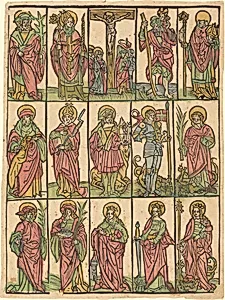
Fourteen Auxiliary Saints
c. 1500
Medium
woodcut, hand-colored in pink-red, green, blue, and yellow
Classification
Department
CG-E
Museum
National Gallery of Art, Washington, D.C.
Credit
Rosenwald Collection
Accession Number
1943.3.721
Rights
Public Domain
Art Historical Context
### Fourteen Auxiliary Saints Created around 1500 by an anonymous German artist of the 15th century, *Fourteen Auxiliary Saints* a vibrant woodcut print, meticulously hand-colored in shades of pink-red, green blue, and yellow. Housed in the National Gallery of Art'swald Collection, this work exemplifies the late Gothic era's fusion of devotional art and emerging print technology. Woodcuts like this allowed for the affordable reproduction of sacred imagery, bringing holy figures into homes and churches across Europe. The "auxiliary saints," also known as the Fourteen Holy Helpers, were immensely popular in German-speaking regions during the late Middle Ages. Venerated as intercessors for specific ailments and dangers—such as plague, storms, or childbirth—these saints offered spiritual protection amid widespread fears of disease and uncertainty. This print likely served as a pious talisman, encouraging prayer and devotion among laypeople. Artistically, the hand-coloring elevates the stark black lines of the woodcut, infusing the composition with lively hues that highlight each saint's attributes and garments. This technique, common in early printmaking, bridged manuscript illumination and mass-produced art, democratizing beauty and faith. A testament to Germany's pioneering role in print culture, it captures a pivotal moment when religious icons became accessible to all.
About the Artist
German 15th Century · 1400–1500
**German 15th Century** The designation "German 15th Century" encompasses a collective of anonymous artists active in the late medieval and early Renaissance periods in Germany, primarily known through their contributions to early printmaking and panel painting. These creators emerged during a transformative era when woodcuts and engravings began democratizing religious imagery, bridging the Goth...