
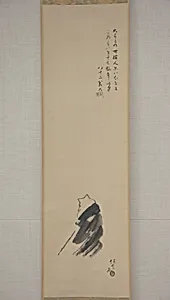
Fox with Staff (Hakuzōsu)
after 1848
Medium
Hanging scroll; ink on paper
Dimensions
Image: 38 1/2 x 11 1/4 in. (97.8 x 28.6 cm) Overall with mounting: 68 1/2 x 11 3/4 in. (174 x 29.8 cm) Overall with knobs: 68 1/2 x 14 in. (174 x 35.6 cm)
Classification
Paintings
Culture & Period
Japan · Edo period (1615–1868)
Department
Asian Art
Museum
Metropolitan Museum of Art, New York, NY
Credit
The Howard Mansfield Collection, Purchase, Rogers Fund, 1936
Accession Number
36.100.95
Rights
Public Domain
Tags
Art Historical Context
**Fox with Staff (akuzōsu)** by Eiraku Hozen, created after 1848, is a captivating hanging scroll painted in ink on paper. Measuring nearly 39 inches tall, this Edo-period (1615–1868) work exemplifies traditional Japanese scroll painting, designed to be unrolled and displayed on special occasions, allowing viewers to appreciate its vertical composition and subtle brushwork in intimate settings. In Japanese folklore, foxes—particularly white ones like this *Hakuzōsu* (white fox messenger)—hold profound cultural significance as divine emissaries of Inari, the Shinto deity of rice, prosperity, and agriculture. Often depicted with a ceremonial staff, they symbolize spiritual guidance and supernatural power. Hozen's minimalist ink technique highlights the fox's ethereal form, using delicate lines and washes to evoke mystery and vitality, a hallmark of late Edo artistic refinement amid Japan's shifting social landscape. Acquired through The Howard Mansfield Collection and now in the Metropolitan Museum of Art's Asian Art Department, this scroll invites visitors to ponder the interplay of myth and artistry in everyday Japanese spirituality. Its compact elegance makes it a perfect gem for contemplating nature's mystical guardians.
About the Artist
Eiraku Hozen · 1795–1854
Eiraku Hozen (1795–1854) was a celebrated Japanese ceramic artist and the sixteenth-generation head of the Nishimura family, a Kyoto dynasty of potters whose work was closely associated with the tastes of the imperial court and the refined aesthetic culture of the ancient capital. Operating under the artistic name Eiraku — a name that would become synonymous with a particular style of elegant, tec...