
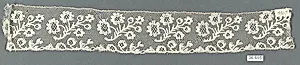
Fragment
Unknown Artist
late 18th century
Medium
Bobbin lace
Dimensions
L. 13 x W. 2 inches (33.0 x 5.1 cm)
Classification
Textiles-Laces
Culture
French, Chantilly
Department
European Sculpture and Decorative Arts
Museum
Metropolitan Museum of Art, New York, NY
Credit
Rogers Fund, 1906
Accession Number
06.655
Rights
Public Domain
Art Historical Context
This delicate *Fragment* of bobbin lace, crafted in late 18th-century France from the renowned Chantilly region, exemplifies the exquisite textile artistry of the Enlightenment era. Measuring just 13 by 2 inches, this slender strip captures the finesse of a craft that adorned the gowns and furnishings of French aristocracy. Chantilly lace, named after the town north of Paris where it flourished, became synonymous with luxury during Louis XVI's reign, blending technical mastery with ornamental elegance. Bobbin lace, the medium here, involves intricate braiding and twisting of fine silk or linen threads on handheld bobbins over a paper pattern pinned to a pillow. Unlike needle lace, this technique allowed for flowing, naturalistic motifs—often floral or scrolling vines—that defined Chantilly's style. Though incomplete, the fragment reveals the lacemaker's precision, with threads as fine as spider silk creating a lightweight, translucent fabric prized for its versatility in fashion and interior decoration. Acquired through the Rogers Fund in 1906, this piece now resides in The Metropolitan Museum of Art's European Sculpture and Decorative Arts collection. It offers a tactile glimpse into pre-Revolutionary opulence, reminding us how such "minor" arts reflected broader cultural splendor and skilled labor traditions that persisted for centuries.