
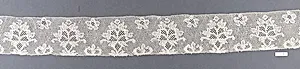
Lace border
Unknown Artist
18th century
Medium
Bobbin lace
Dimensions
L. 34 1/8 x W. 2 1/2 inches (86.7 x 6.4 cm)
Classification
Textiles-Laces
Culture
Flemish, Antwerp
Department
European Sculpture and Decorative Arts
Museum
Metropolitan Museum of Art, New York, NY
Credit
Gift of Miss Julia Chester Wells, 1913
Accession Number
13.216.3
Rights
Public Domain
Art Historical Context
This exquisite *Lace Border* hails from 18th-century Antwerp, a renowned hub of Flemish lace-making where artisans elevated textiles to fine art. Crafted as bobbin lace—a technique using multiple bobbins to twist and intertwine fine threads into intricate, symmetrical patterns—this narrow strip measures 34⅛ × 2½ inches (86.7 × 6.4 cm). Its delicate motifs likely served as an elegant edging for garments, linens, or furnishings, embodying the opulence of Baroque-era fashion among Europe's elite. Bobbin lace, distinct from needle lace for its woven structure, demanded extraordinary skill and patience, with Antwerp workshops producing some of the world's most prized examples. In the 18th century, Flemish lace symbolized luxury trade, exported across continents and influencing global decorative arts. This piece reflects that legacy, showcasing the precision and floral-inspired designs typical of the region. A generous gift to the Metropolitan Museum of Art from Miss Julia Chester Wells in 1913, it now resides in the Department of European Sculpture and Decorative Arts. Visitors can appreciate how such textiles blurred the line between craft and masterpiece, offering a tactile glimpse into Flemish cultural heritage.