
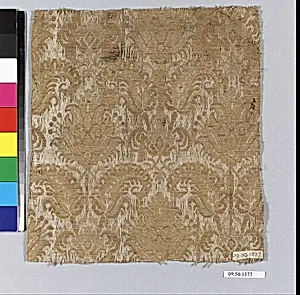
Fragment
Unknown Artist
19th century
Medium
Silk and cotton
Dimensions
9 1/2 x 8 1/2 inches (24.1 x 21.6 cm)
Classification
Textiles-Woven
Culture
German
Department
European Sculpture and Decorative Arts
Museum
Metropolitan Museum of Art, New York, NY
Credit
Rogers Fund, 1909
Accession Number
09.50.1577
Rights
Public Domain
Art Historical Context
This delicate *Fragment*, a woven textile from 19th-century Germany, offers a glimpse into the refined world of European decorative arts.ed from silk and cotton, it measures a modest 9½ x 8½ inches (24.1 x 21.6 cm), suggesting it is a surviving piece of a larger fabric—perhaps used for upholstery, clothing, or ecclesiastical vestments. Acquired through the Rogers Fund in 1909 and now housed in the Metropolitan Museum Art's Department of European Sculpture and Decor Arts, it exemplifies the meticulous craftsmanship of German textile production during an era of rapid industrialization. The use of silk, prized for its luster and sheen, combined with durable cotton, highlights innovative blending of luxury and practicality in woven textiles. German weaving centers, such as those in Saxony, were renowned for intricate patterns achieved through advanced looms, though the artist's anonymity underscores the collaborative nature of textile workshops. This fragment preserves techniques that bridged traditional handcraft with emerging mechanization, reflecting broader cultural shifts toward opulent domestic interiors in the Biedermeier and Victorian periods. As a classified "Textiles-Woven" artifact, it invites visitors to appreciate the tactile artistry often overlooked in grand painting collections, reminding us of textiles' vital role in everyday elegance and cultural identity.