
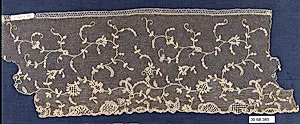
Fragment
Unknown Artist
19th century
Medium
Needle lace, point d’Alençon
Dimensions
L. 12 1/2 x W. 4 3/4 inches 31.8 x 12.1 cm
Classification
Textiles-Laces
Culture
French
Department
European Sculpture and Decorative Arts
Museum
Metropolitan Museum of Art, New York, NY
Credit
Purchase by subscription, 1909
Accession Number
09.68.385
Rights
Public Domain
Art Historical Context
This delicate fragment of needle lace, crafted in the renowned point d’Alençon technique during the 19th century exemplifies the pinnacle of French lace-making artistry. Measuring 12½ by 4¾ inches, this anonymous work from the European Sculpture and Decorative Arts collection at The Metropolitan Museum of Art showcases the intricate buttonhole stitches that define point d’Alençon.inating in Alençon, France, method—perfected in royal workshops since the 17th century—involves drawing designs on vellum and meticulously building motifs with fine linen thread, creating a lightweight, sculptural fabric prized for its realism and precision. In the 19th century, point d’Alençon lace symbolized luxury and technical mastery, often adorning elite fashion like wedding veils and ecclesiastical vestments. Protected by French royal patents and later state regulations, its production was a closely guarded craft, blending artistry with near-invisible engineering. Though just a fragment, this piece hints at larger garments or altar cloths, preserving a vanishing tradition amid industrialization. Acquired by Met subscribers in 1909, it invites visitors to marvel at the patience required—hours per square inch—and the cultural prestige of French decorative arts, bridging fashion, sculpture, and heritage in a single, ethereal swatch.