
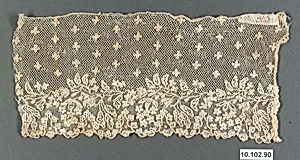
Fragment
Unknown Artist
19th century
Medium
Needle lace, point d’Alençon
Dimensions
L. 7 1/2 x W. 3 1/4 inches 19.1 x 8.3 cm
Classification
Textiles-Laces
Culture
French
Department
European Sculpture and Decorative Arts
Museum
Metropolitan Museum of Art, New York, NY
Credit
Henrietta Seligman Lace Collection, Bequest of Mrs. Jesse Seligman, 1910
Accession Number
10.102.90
Rights
Public Domain
Art Historical Context
This delicate fragment of needle lace exemplifies the pinnacle of 19th-century French craftsmanship in point d’Alençon, a luxurious technique originating from the town of Alençon in. Measuring just 7½ by 3¼ inches, this small yet intricate piece was likely part of a larger garment, collar, or ecclesiastical trimming, showcasing the meticulous needlework that defined elite European fashion and decor. Point d’Alençon lace, with its fine linen threads stitched entirely by hand, features raised motifs, picots, and delicate buttonhole stitches that create a sculptural, almost three-dimensional quality—hallmarks of a craft so revered it received royal patronage from Louis XIV and state protection into the modern era. In the 19th century, as industrialization threatened traditional lacemaking, artisans in Alençon preserved this labor-intensive method, producing pieces for aristocracy and high society. Each square inch could take weeks to complete, reflecting not just technical virtuosity but also France’s cultural prestige in decorative arts. This fragment, from the esteemed Henrietta Seligman Lace Collection bequeathed to The Metropolitan Museum of Art in 1910, invites us to marvel at the unseen hands behind such ephemeral beauty, a testament to the artistry of anonymous makers whose work adorned the world’s finest wardrobes.