
Fragment
Unknown Artist
18th century
Medium
Bobbin lace
Dimensions
L. 7 1/2 x W. 1 1/2 inches 19.1 x 3.8 cm
Classification
Textiles-Laces
Culture
Flemish
Department
European Sculpture and Decorative Arts
Museum
Metropolitan Museum of Art, New York, NY
Credit
Gift of Miss Julia Chester Wells, 1910
Accession Number
10.146.17
Rights
Public Domain
Art Historical Context
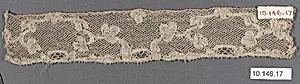
This exquisite *Fragment* of bobbin lace, crafted by an unknown Flemish artist in the 18th century offers a glimpse into the pinnacle of European textile artistry. Measuring just 7½ by 1½ inches (19.1 x 3.8 cm), this piece exemplifies the precision and patience required in bobbin lace-making, a technique where threads wound on small bobbins are twisted and braided around pins set in a pattern on a pillow. Flemish lacemakers, centered in regions like Brussels and Mechlin, were renowned for their intricate designs, often featuring floral motifs or geometric patterns that adorned elite fashion—think ruffled cuffs, collars, and veils. In the 18th century, amid the opulence of the Rococo era, bobbin lace represented luxury and status, rivaling gold and jewels in aristocratic wardrobes. Its creation demanded skilled hands, sometimes taking months for larger pieces, highlighting the anonymous labor of women artisans who preserved Flanders' lace legacy from Renaissance roots. Though a mere fragment, it survives as a testament to this vanishing craft, preserved through the generosity of Miss Julia Chester Wells's 1910 gift to The Metropolitan Museum of Art. Housed in the Department of European Sculpture and Decorative Arts, this lace invites us to marvel at its delicate weave under magnification, whispering stories of 18th-century refinement and the cultural prestige of Flemish textiles.