
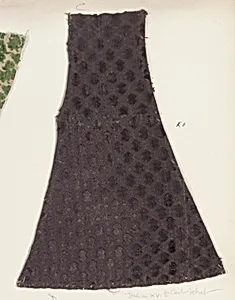
Fragment
Unknown Artist
16th century
Medium
Silk
Dimensions
Overall: 11 1/8 x 8 3/8 in. (28.3 x 21.3 cm)
Classification
Textiles-Velvets
Culture
Italian
Department
European Sculpture and Decorative Arts
Museum
Metropolitan Museum of Art, New York, NY
Credit
Gift of Nanette B. Kelekian, in honor of Olga Raggio, 2002
Accession Number
2002.494.502
Rights
Public Domain
Art Historical Context
This exquisite silk velvet fragment, hailing from 16th-century Italy, offers a tantalizing glimpse into the opulence of Renaissance decorative arts. Measuring just 11 1/8 x 8 3/8 inches (28.3 x 21.3 cm), this small yet sumptuous piece showcases the mastery of Italian weavers, who were renowned for producing luxurious textiles that adorned the garments and furnishings of Europe's elite. Crafted during the height of the Italian Renaissance, when cities like Venice, Florence, and Genoa dominated the silk trade routes from the East, this velvet exemplifies advanced weaving techniques. The medium's characteristic pile—short, dense fibers cut to create a plush texture—required skilled labor on specialized looms, often incorporating intricate patterns inspired by nature, motifs, or heraldry. Such velvets symbolized wealth and status, traded across continents and featured in portraits by artists like Titian. Today, housed in the Metropolitan Museum of Art's Department of European Sculpture and Decorative Arts (gift of Nanette B. Kelekian in honor of Olga Raggio, 2002), this fragment preserves a slice of Italy's textile heritage. Though incomplete, it invites us to imagine its original splendor in a noble's velvet doublet or ecclesiastical vestment, highlighting the enduring allure of Renaissance craftsmanship.