
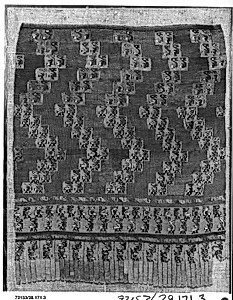
Fragment
Unknown Artist
12th–14th century
Medium
Camelid hair, cotton
Dimensions
Overall: 28 1/2 x 34 3/4 in. (72.39 x 88.27 cm) Other: 28 1/2 in. (72.39 cm)
Classification
Textiles-Woven
Culture
Chancay
Department
Arts of Africa, Oceania, and the Americas
Museum
Metropolitan Museum of Art, New York, NY
Credit
Rogers Fund, 1928
Accession Number
28.171.3
Rights
Public Domain
Tags
Art Historical Context
This striking textile fragment, created by an unknown Chancay artist between the 12th and 14th centuries, hails from the Chancay culture of Peru's central coast. Flourishing during the Late Intermediate Period, the Chancay people were renowned for their vibrant textiles, often used in burials and daily life to convey status and spiritual beliefs. Acquired through the Rogers Fund in 1928, this piece now graces the Metropolitan of Art's Department of of Africa, Oceania, the Americas. Woven camelid hair—likely from alpacas or vicuñas—and cotton, the fabric measures an impressive 28½ x 34¾ inches, demonstrating the Chancay's mastery of double-cloth weaving techniques. This method created layered, reversible designs with bold colors and motifs, including birds, which recur in their iconography as symbols of the sky, fertility, or messengers between worlds. The use of fine camelid fibers added durability and a luxurious sheen, while cotton provided breathability suited to the coastal climate. As a surviving fragment, it offers a window into pre-Columbian artistry, where textiles rivaled ceramics in cultural prestige. These works highlight the Chancay's ingenuity in transforming natural fibers into storytelling canvases, preserving their legacy for modern visitors.