
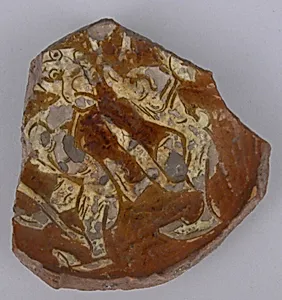
Fragment
Unknown Artist
14th century
Medium
Earthenware; incised decoration through a white slip and coloring under transparent glaze
Classification
Ceramics
Department
Islamic Art
Museum
Metropolitan Museum of Art, New York, NY
Credit
Rogers Fund, 1907
Accession Number
07.238.39
Rights
Public Domain
Art Historical Context
This exquisite *Fragment* from the th century offers a glimpse into the masterful ceramics of the Islamic world. Crafted from earthenware, it features incised decoration through a white slip—a fine layer of liquid clay—revealing the body beneath, with added coloring sealed under a transparent glaze. This technique known as sgraffito or slip-incising, was a hallmark of Islamic potters, allowing for precise, layered designs that played with light and color once fired. In the vibrant tradition of Islamic art, such ceramics flourished across regions like Persia and the Levant during the medieval period, adorning tableware, tiles, and vessels with intricate motifs. Though incomplete, this fragment showcases the technical sophistication and aesthetic refinement of the era, where artisans balanced functionality with beauty under Islamic aniconism, favoring geometric and floral patterns. Acquired through the Rogers Fund in 1907, it resides in The Metropolitan Museum of Art's Islamic Art department, preserving a tangible link to a golden age of craftsmanship. Visitors will appreciate how this modest shard reflects the ingenuity of anonymous makers, whose innovations influenced global ceramics for centuries.