
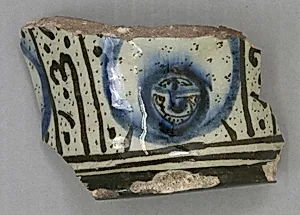
Fragment
Unknown Artist
14th century
Medium
Stonepaste; white slip; blue and black underglaze; transparent, colorless glaze
Classification
Ceramics
Department
Islamic Art
Museum
Metropolitan Museum of Art, New York, NY
Credit
Rogers Fund, 1907
Accession Number
07.238.40
Rights
Public Domain
Art Historical Context
This exquisite *Fragment* from the th century exemplifies the pinnacle of Islamic ceramic innovation during the medieval Islamic world, likely originating from regions like Persia or Syria under Mongol-influenced dynasties such as the Ilkhanids or Mamluks. Craft in stonepaste—a composite of quartz, clay, and frit that mimicked the translucency of coveted Chinese porcelain—this shard showcases the technical mastery of artisans who developed durable, high-fired bodies ideal for intricate decoration. The surface features white slip as a base, adorned with blue and black underglaze motifs painted before a transparent, colorless glaze was applied and fired. This underglaze technique, perfected in the 12th–14th centuries, allowed vibrant colors to endure without fading, revolutionizing ceramic production. Common in tiles, vessels, and architectural elements, such fragments often depicted floral arabesques, geometric patterns, or calligraphy, reflecting Islamic aniconism and the era's fascination with optical effects and mathematical harmony. Acquired through the Rogers Fund in 1907 and housed in the Metropolitan Museum of Art's Islamic Art Department, this piece invites us to ponder the Silk Road's cultural exchanges, where Islamic potters pushed material boundaries, influencing global ceramics for centuries. Though incomplete, its preserved luster whispers tales of opulent palaces and bustling bazaars.