
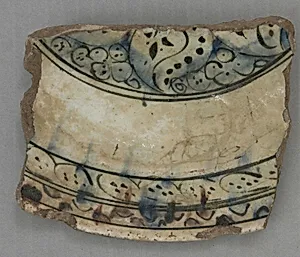
Fragment
Unknown Artist
13th–14th century
Medium
Stonepaste; painted under transparent glaze
Classification
Ceramics
Department
Islamic Art
Museum
Metropolitan Museum of Art, New York, NY
Credit
Rogers Fund, 1908
Accession Number
08.256.162
Rights
Public Domain
Art Historical Context
This enigmatic *Fragment* from the th–14th century a glimpse into the golden age of Islamic ceramics, by an unknown artist using innovative stonepaste—a composite of quartz, clay, and frit (glass powder) fired to mimic the translucency of coveted Chinese porcelain. Developed in the Islamic world around the 9th century, stonepaste allowed artisans in regions like Iran, Syria, and Egypt to create durable, high-quality vessels and tiles that surpassed local clays in refinement. The piece features painting under a transparent glaze, a technique perfected during the medieval Islamic period under dynasties like the Ilkhanids and Mamluks. Pigments were applied directly to the unfired body before glazing and firing, producing vibrant, lasting colors protected from wear. Though just a fragment, it exemplifies the era's artistic prowess, where ceramics blended functionality with ornate decoration inspired by nature, calligraphy, and geometry—hallmarks of Islamic design. Acquired through the Rogers Fund in 1908, this artifact at the Metropolitan Museum of Art highlights the cultural exchange along Silk Road trade routes, underscoring ceramics' role in daily life, architecture, and diplomacy in the medieval Islamic world. A small shard, yet a testament to enduring ingenuity!