
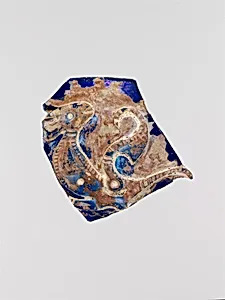
Fragment
Unknown Artist
9th century
Medium
Glass, blue and opaque white; blown, cased, cut
Dimensions
H. 2 3/4 in. (7 cm) W. 2 3/4 in. (7 cm)
Classification
Glass
Department
Islamic Art
Museum
Metropolitan Museum of Art, New York, NY
Credit
Rogers Fund, 1940
Accession Number
40.170.181
Rights
Public Domain
Art Historical Context
This delicate glass fragment, hailing from the 9th century and part of the Metropolitan Museum of Art's Islamic collection, offers a glimpse into the golden of Abbasid-era craftsmanship. Likely a remnant of a larger vessel or decorative object, its modest dimensions—about 2¾ inches square—belie the sophistication of the Islamic world's glassmaking traditions, centered in regions like Mesopotamia, Syria, and Egypt. Acquired through the Rogers Fund in 0, it exemplifies the artistry that flourished under Islamic patronage, where glass was prized for both utility and beauty. Crafted from vibrant blue glass with opaque white casing, the piece showcases advanced techniques: first blown into shape for thinness and lightness, then cased with a layer of opaque white glass, and finally meticulously cut to reveal intricate patterns or contrasts. This labor-intensive process, perfected by Islamic artisans, allowed for luminous effects and precise designs that influenced European glasswork for centuries. The interplay of translucent blue and milky white evokes the era's love for color harmony and optical play. Though incomplete, this fragment whispers of opulent tableware or mosque lamps used in daily life and ritual, highlighting glass's role as an accessible luxury in medieval Islamic society. A testament to forgotten hands, it invites us to marvel at enduring innovation.