
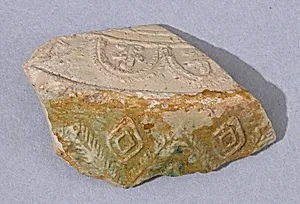
Fragment
Unknown Artist
9th century
Medium
Earthenware; molded decoration, glazed
Classification
Ceramics
Department
Islamic Art
Museum
Metropolitan Museum of Art, New York, NY
Credit
Gift of Mr. and Mrs. Wendell M. Hastings, 1960
Accession Number
60.23.28
Rights
Public Domain
Art Historical Context
This exquisite *Fragment* from the th century offers a glimpse into the vibrant of early Islamic ceramics. Crafted from earthenware with molded decoration and a glossy glaze, it hails from the Metropolitan Museum of Art's Islamic Art department, generously gifted by Mr. and. Wendell M. Hastings 1960. Though only a fragment survives, it exemplifies the technical sophistication of pottery during the Abbasid era, a time when Baghdad was a hub of innovation under the Islamic Golden Age. The use of molded decoration—a technique where clay was pressed into carved molds to create raised motifs—allowed artisans to produce intricate patterns efficiently, often featuring geometric or vegetal designs symbolic of paradise gardens in Islamic culture. The overlying glaze not only sealed the surface for durability but also created a luminous sheen, transforming everyday earthenware into objects of beauty suitable for tableware or architectural elements. Surviving fragments like this highlight the cultural importance of ceramics in 9th-century Islamic society, where pottery bridged utility and artistry. They reflect trade networks spanning the Middle East and beyond, preserving motifs that influenced later traditions in lusterware and tilework. A small treasure, it invites us to marvel at the anonymous craftsman's skill and the enduring legacy of Islamic ingenuity.