
Fragment
Unknown Artist
probably 13th–14th century
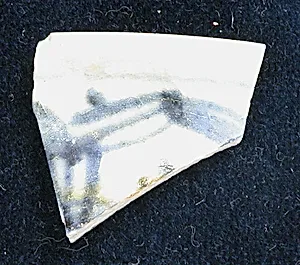
Medium
Porcelain
Dimensions
H. 15/16 in. (2.4 cm) W. 1 in. (2.5 cm) D. 1/4 in. (0.6 cm) Wt. 0.1 oz. (2.8 g)
Classification
Ceramics
Department
Islamic Art
Museum
Metropolitan Museum of Art, New York, NY
Credit
Gift of Mr. and Mrs. Wendell M. Hastings, 1960
Accession Number
60.23.93
Rights
Public Domain
Art Historical Context
This petite porcelain fragment, no larger than a thumbnail (H. 15/16 in.), offers a glimpse into the refined artistry of the 13th–14th century world. Housed in the Metropolitan Museum of Art's of Islamic Art, it was generously gifted by Mr. and Mrs. Wendell M. Hastings in 1960. Though its exact form—perhaps part of a vessel, tile or decorative object—remains a mystery due to its fragmentary state, its survival speaks to the durability of porcelain, a high-fired ceramic prized for its luminous white body and subtle translucency. Porcelain's presence in Islamic collections underscores the vibrant Silk Road trade networks linking the Middle East, Persia, and China during the Mongol era (Ilkhanid period). While true porcelain originated in China, its importation to the Islamic realms symbolized luxury and cultural exchange, inspiring local potters to experiment with stonepaste and tin-glazed alternatives. This fragment's featherlight weight (0.1 oz.) highlights the technical mastery involved: kaolin clay vitrified at intense temperatures to achieve an impermeable, resonant surface. For visitors, it evokes the opulence of medieval Islamic courts, where such imports adorned tables and mosques, blending Eastern innovation with regional aesthetics. A tiny testament to global connectivity!