
Fragment
Unknown Artist
probably 13th–14th century
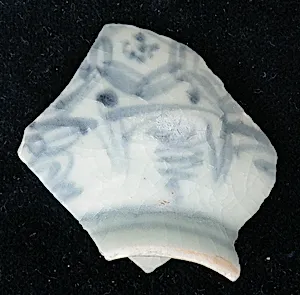
Medium
Porcelain
Dimensions
H. 13/16 in. (2.1 cm) W. 1 13/16 in. (4.6 cm) D. 1 3/8 in. (3.5 cm) Wt. 0.6 oz. (17 g)
Classification
Ceramics
Department
Islamic Art
Museum
Metropolitan Museum of Art, New York, NY
Credit
Gift of Mr. and Mrs. Wendell M. Hastings, 1960
Accession Number
60.23.94
Rights
Public Domain
Art Historical Context
This delicate porcelain fragment, likely from the 13th or 14th century, offers a tantalizing glimpse into the opulent world of medieval Islamic art and global trade. Measuring just 13/16 inches high and weighing a mere 0.6 ounces, it is a tiny survivor—possibly from a vessel, tile, or decorative object—crafted with the translucent, high-fired porcelain that originated in China. Such pieces were highly prized in the Islamic world, where they symbolized luxury and technical mastery, often imported via the Silk Road during the Mongol Ilkhanid and Mamluk eras. Porcelain's significance in this context lies in its rarity and allure. Unlike the stonepaste ceramics commonly produced in Persian and Syrian workshops, true porcelain represented Eastern innovation, evoking wonder among collectors and rulers. Its smooth, vitrified surface and subtle sheen would have gleamed in palace settings or scholarly collections, bridging cultures across continents. Though worn by time, this fragment whispers of vibrant exchange networks that connected East Asia to the Middle East. Generously gifted to the Metropolitan Museum of Art in 1960 by Mr. and Mrs. Wendell M. Hastings, it now resides in the Islamic Art department, reminding visitors of how even the smallest artifacts illuminate history's grand tapestry.