
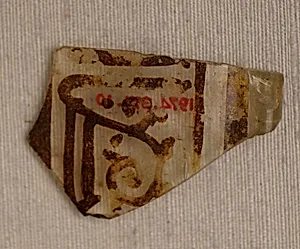
Fragment
Unknown Artist
9th century
Medium
Glass; stained and luster-painted
Dimensions
H. 1 1/2 in. (3.8 cm) W. 1 in. (2.5 cm)
Classification
Glass
Department
Islamic Art
Museum
Metropolitan Museum of Art, New York, NY
Credit
Gift of Saeed Motamed, 1974
Accession Number
1974.371.10
Rights
Public Domain
Art Historical Context
This delicate glass fragment, hailing from the 9th century, a glimpse into the sophisticated artistry of the Islamic world during the Abbasid. Measuring just 1 1/2 inches high and 1 inch wide it exemplifies the miniaturist's skill in creating luxurious objects for elite patrons. Likely part of a larger vessel or decorative item, its survival as a treasured remnant speaks to the enduring allure of Islamic glasswork. Crafted using stained glass—where metal oxides tint the molten material—and enhanced with luster-painting, a groundbreaking technique involving metallic oxides fired onto the surface for an iridescent sheen, this piece highlights technical innovation. Developed in regions like Iraq and Syria, lusterware represented the pinnacle of 9th-century glass production, rivaling ceramics in opulence and often reserved for tableware, lamps, or architectural elements in mosques and palaces. Displayed in the Metropolitan Museum of Art's Islamic Art Department, thanks to a 1974 gift from Saeed Motamed, this fragment invites us to marvel at the cultural flourishing of the time. It underscores how Islamic artisans blended functionality with beauty, influencing global decorative arts for centuries.