
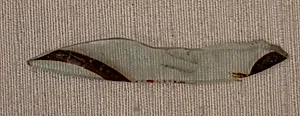
Fragment
Unknown Artist
9th century
Medium
Glass; stained and luster-painted
Dimensions
H. 1/4" (0.6 cm) L. 2" (5.1 cm)
Classification
Glass
Department
Islamic Art
Museum
Metropolitan Museum of Art, New York, NY
Credit
Gift of Saeed Motamed, 1974
Accession Number
1974.371.12
Rights
Public Domain
Art Historical Context
This delicate glass fragment, dating to the 9th, hails from the golden age of Islamic art under the Abbasid Caliphate. Measuring just ¼ inch high and 2 inches long it exemplifies the exquisite craftsmanship of artisans in regions like Iraq or Syria, where glassmaking flourished as a luxury trade. Likely part of a vessel, beaker, or decorative object, its small scale belies the sophistication of techniques that made Islamic glass coveted across Eurasia. The fragment's medium—stained and luster-painted glass—highlights two innovative methods. Staining involved adding metal oxides to molten glass for vibrant, permanent colors, while luster-painting applied a metallic solution (often copper or silver) that was fired in a reducing atmosphere, yielding a shimmering, iridescent sheen reminiscent of gold. These processes, perfected by Islamic craftsmen around the 9th century, not only enhanced beauty but also demonstrated mastery over fire and chemistry, influencing later European traditions like Venetian glass. Preserved through the generous gift of Saeed Motamed in 1974, this piece at the Metropolitan Museum of Art invites us to marvel at the ingenuity of anonymous creators whose work bridged art, science, and daily splendor in medieval Islamic culture.