
Fragment
Unknown Artist
9th century
Medium
Glass; stained and luster-painted
Dimensions
H. 1/4" (0.6 cm) L. 1 5/16" (3.4 cm)
Classification
Glass
Department
Islamic Art
Museum
Metropolitan Museum of Art, New York, NY
Credit
Gift of Saeed Motamed, 1974
Accession Number
1974.371.14
Rights
Public Domain
Art Historical Context
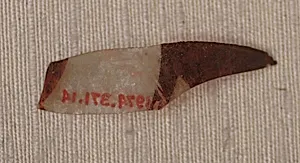
This delicate glass fragment, hailing from the 9th century offers a glimpse into the sophisticated artistry of the Islamic world during the Abbasid era. Measuring a mere 1/4 inch high and1 5/16 inches long, it survives as a tiny shard, likely from a larger vessel or decorative object. Now housed in the Metropolitan Museum of Art's Department of Islamic Art, it was generously gifted by Saeed Motamed in 4. Crafted using stained and luster-painted techniques, the piece exemplifies early mastery of glassmaking innovations. Staining involved adding metallic oxides to create vibrant colors within the glass, while luster-painting applied a thin metallic film—typically gold or copper—fired at low temperatures to produce an iridescent sheen that shimmered like metal. These methods, pioneered in regions like Iraq and Egypt around the 9th century, marked a golden age for Islamic glass, blending functionality with opulent beauty for elite tableware, lamps, and mosque decorations. Though incomplete, this fragment highlights the cultural prestige of luster glass, traded across empires and admired for its technical brilliance. It invites us to imagine the luminous banquets and sacred spaces where such treasures once glowed, preserving a spark of medieval ingenuity.