
Fragment
900 CE-1470
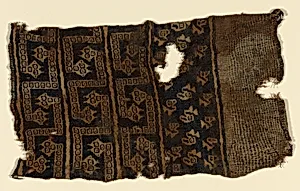
Medium
Cotton, plain weave with paired warps; center: cotton, plain weave double cloth; two selvages present
Dimensions
35.8 × 20.8 cm (14 × 8 1/8 in.) weft repeat: 5.8 cm 2 1/4 in.
Classification
textile
Department
Textiles
Museum
Art Institute of Chicago
Accession Number
152934
Rights
Public Domain
Art Historical Context
This exquisite textile fragment hails from the Chancay culture, a pre-Columbian society that thrived along Peru's central coast between 900 and 1470 CE. The Chancay people were renowned for their masterful weaving, producing garments, shrouds, and ceremonial objects that reflected their vibrant worldview. Though only a small piece survives—measuring 35.8 × 20.8 cm—this artifact offers a window into their sophisticated craftsmanship, preserved in the Art Institute of Chicago's Textiles Department. Crafted from cotton using a plain weave with paired warps, the fragment features a central panel of plain weave double cloth, a technique that creates two layered fabrics interwoven on the same loom for added depth and durability. The presence of two selvages—finished edges that prevented fraying—highlights the weavers' precision. A repeating weft pattern every 5.8 cm suggests rhythmic motifs, possibly geometric or symbolic designs typical of Chancay textiles, used in daily life or funerary contexts. As a testament to Andean textile innovation, this fragment underscores the Chancay's cultural emphasis on fiber arts, where weaving was both an economic staple and a spiritual practice. Visitors can marvel at how such humble materials conveyed complex stories across centuries.
About the Artist
Chancay
The Chancay were a pre-Columbian culture that flourished along the central coast of Peru, in the valleys of the Huaura, Chancay, Chillón, and surrounding rivers, from approximately 1000 to 1470 CE. Emerging after the decline of the Wari civilization, the Chancay developed a distinctive artistic identity that set them apart from their Andean contemporaries, one defined above all by extraordinary ma...