
Fragment
Mid–17th century
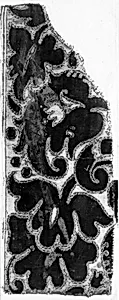
Medium
cisele voided satin velvet
Classification
textile
Department
Textiles
Museum
Art Institute of Chicago
Accession Number
62156
Rights
Public Domain
Art Historical Context
This exquisite *Fragment* from the mid-17th century showcases the pinnacle of textile artistry in an era of lavish Baroque opulence. Crafted in *cisele voided satin velvet*, it exemplifies a sophisticated weaving technique where intricate motifs are created by selectively cutting the pile at varying heights—one left long for bold relief, the other clipped short for a subtle sheen. This labor-intensive process, often requiring skilled looms and master weavers, produced a three-dimensional effect that mimicked embroidery without added stitching, highlighting the era's fusion of technology and aesthetics. Housed in the Art Institute of Chicago's Textiles Department, this anonymous fragment likely originated from grand furnishings, garments, or ecclesiastical vestments, reflecting the period's obsession with luxury fabrics. Satin velvet, prized for its luminous surface and rich texture, was a status symbol traded across Europe and the Ottoman Empire, symbolizing wealth and refinement amid the sumptuous courts of Louis XIV and Charles I. Though small, such fragments preserve vital glimpses into 17th-century craftsmanship, revealing how textiles were not mere utilities but canvases for artistic innovation. Visitors can marvel at the tactile interplay of light and shadow, a testament to the unsung heroes of the loom.
About the Artist
Unknown
The artist designated as "Unknown" in our virtual museum's collection exemplifies a poignant chapter in art history: creators whose identities have faded into obscurity despite the enduring power of their work. With only one known artwork attributed to them in our holdings, this figure represents countless anonymous hands that shaped visual culture across centuries. Museums worldwide, including th...