
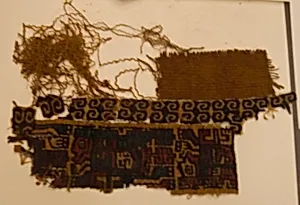
Fragment
700 CE-900 CE
Medium
Slit tapestry and plain cloth. Applied paint gold colored border
Dimensions
22.9 × 14 cm (9 × 5 1/2 in.)
Classification
textile
Department
Textiles
Museum
Art Institute of Chicago
Accession Number
85353
Rights
Public Domain
Art Historical Context
This exquisite *Fragment* from the Nas culture (ca. 700–900 CE) offers a glimpse into one of ancient Peru's most masterful textile traditions. Created during the late phase of the Nasca civilization in southern Peru, this small piece (22.9 × 14 cm) exemplifies the renowned skill in weaving, housed today in the Art Institute of's Textiles Department. The Nasca people, famous for their geoglyphs like the Nazca Lines and ceramics, produced textiles that served as symbols of status, ritual, and cosmology. Crafted in slit tapestry—a technique where weft yarns interlock at color boundaries to form crisp, pictorial designs—the fragment combines intricate weaving with plain cloth and applied paint mimicking a gold border. This innovative use of paint to imitate precious metals highlights the Nasca's ingenuity in elevating textiles to rival the sheen of goldwork, a common Andean practice. Slit tapestry allowed for bold, geometric motifs and figurative scenes, though this surviving fragment invites us to imagine its original vibrancy in burials or ceremonies. Nasca textiles like this one underscore the culture's artistic peak before its decline around 800 CE, possibly due to environmental stresses. As portable treasures, they traveled through trade and ritual, preserving myths of warriors, deities, and nature. For visitors, this fragment reveals how everyday fibers became canvases for eternal stories.
About the Artist
Nasca
Nasca artists, active from approximately 100 BCE to 800 CE along the arid southern coast of Peru in the Rio Grande de Nazca and Ica Valleys, produced some of the most vibrant and technically innovative art of the ancient Americas. Their work emerged from the Paracas tradition, expanding on earlier resin-painted ceramics and complex textiles while introducing pre-fire slip painting in up to twelve ...