
Tunic Fragment
Unknown Artist
7th–9th century
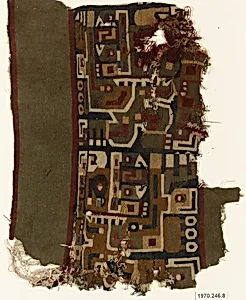
Medium
Camelid hair, cotton
Dimensions
H.7 7/8 x 10 5/8 in. (20 x 27 cm)
Classification
Textiles-Woven
Culture
Wari
Department
Arts of Africa, Oceania, and the Americas
Museum
Metropolitan Museum of Art, New York, NY
Credit
Gift of Dr. and Mrs. Howard Russell Hartman, 1970
Accession Number
1970.246.8
Rights
Public Domain
Art Historical Context
This exquisite tunic fragment hails from the Wari culture of ancient Peru, flourishing between the 7th and 9th centuries in Andean highlands. The Wari were masterful weavers whose textiles served as symbols of power, status, and cosmology, often adorning elite tunics worn by rulers and priests. Donated to the Metropolitan Museum of Art 1970 by Dr. and Mrs. Howard Russell, this small yet vibrant piece (measuring 7⅞ x 10⅝ inches) offers a glimpse into a sophisticated pre-Inca society renowned for its imperial expansion and artistic innovation. Crafted from camelid hair—likely from alpacas or llamas—and cotton, the fragment exemplifies Wari weaving techniques. These fibers were skillfully combined for durability and rich color retention, with camelid wool providing warmth and a luxurious texture ideal for highland climates. Woven textiles like this were labor-intensive, produced on backstrap looms, and often featured intricate geometric patterns or motifs repeating across garments, reflecting the culture's advanced mathematical precision and spiritual beliefs. As a surviving remnant of daily and ceremonial life, this artifact underscores the Wari's pivotal role in Andean textile traditions, influencing later Inca artistry. Though incomplete, it invites us to imagine the full tunic's grandeur, connecting visitors to the ingenuity of a vanished world.