
Fragment
Mamluk period (1250–1517), 14th/15th century
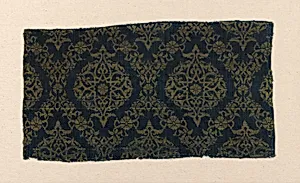
Medium
Silk, warp-float faced 4:1 satin weave with supplementary patterning wefts bound by secondary binding warps in plain interlacings
Dimensions
20.8 × 38.2 cm (8 1/4 × 15 in.); Weft repeat: H.: 14.2 cm (5 5/8 in.)
Classification
textile
Department
Textiles
Museum
Art Institute of Chicago
Accession Number
99500
Rights
Public Domain
About this artwork
Textiles held an important place in all Muslim courts, including that of the Mamluks in Egypt and Syria. The appeal of woven fabrics lay in their rich colors, elaborate patterns, and luxury materials such as silk and metal thread. Some woven silks were hung as wall decorations; others were made into robes worn by members of the court or given as official gifts to rulers of neighboring regions.
About the Artist
Islamic
Islamic art, a profound visual tradition originating in the 7th century CE, flourished across vast territories from Spain to India under Muslim rule, encompassing architecture, ceramics, manuscripts, textiles, and metalwork produced by diverse artisans rather than a single named master. Drawing from pre-Islamic Sasanian, Byzantine, and late antique influences, its early development under the Umayy...