
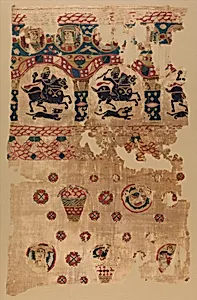
Fragment from a Coptic Hanging
Unknown Artist
5th century
Medium
Linen, wool; plain weave, tapestry-weave
Dimensions
Textile: L. 40 15/16 in. (104 cm) W. 24 13/16 in. (63 cm) Mount: L. 46 1/4 in. (117.5 cm) W. 31 1/8 in. (79.1 cm) D. 2 1/4 in. (5.7 cm) Wt. 30 lbs. (13.6 kg)
Classification
Textiles-Rugs
Department
Islamic Art
Museum
Metropolitan Museum of Art, New York, NY
Credit
Gift of George F. Baker, 1890
Accession Number
90.5.905
Rights
Public Domain
Tags
Art Historical Context
This exquisite *Fragment from a Coptic*, dating to the 5th, offers a glimpse into the vibrant traditions of early Christian Egypt. Crafted from linen and wool using plain weave for the sturdy ground fabric and tapestry weave for intricate motifs, it exemplifies the technical mastery of Coptic weavers. The discontinuous weft technique in tapestry weave allowed for bold, colorful patterns—likely featuring dynamic horses, as suggested by the artwork's tags—without wasting precious yarn. At over 40 inches long, this substantial fragment was probably part of a larger hanging used to adorn homes, churches, or tombs. Coptic textiles like this one bridged late antique Greco-Roman styles with emerging Christian iconography, blending everyday motifs like animals with symbolic depth. Horses, often depicted in profile or in procession, evoked power, fertility, and biblical narratives, reflecting Egypt's multicultural heritage under Roman and Byzantine rule. Produced in weaving centers like Akhmim, these pieces were luxury goods traded across the Mediterranean, showcasing wool's rich dyes against linen's crisp texture. Now housed in the Metropolitan Museum of Art's Department of Islamic Art—highlighting continuities into later periods—this rare survivor, gifted in 1890, reminds us of everyday artistry in a world of pharaohs and saints. A testament to ancient ingenuity, it invites us to imagine the lively spaces it once graced.