
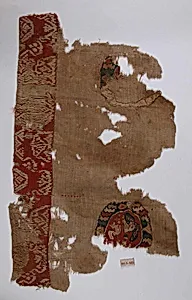
Fragment of a Tunic
Unknown Artist
5th–6th century
Medium
Wool, linen; plain weave, tapestry weave
Dimensions
Max. H. 14 in. (35.6 cm) Max. W. 8 1/8 in. (20.6 cm)
Classification
Textiles
Department
Islamic Art
Museum
Metropolitan Museum of Art, New York, NY
Credit
Gift of George F. Baker, 1890
Accession Number
90.5.351
Rights
Public Domain
Art Historical Context
This delicate **Fragment of a Tunic**, dating to the 5th–6th century, offers a glimpse into the everyday artistry of late antique textile production in regions now associated with Islamic culture. Crafted from wool and linen using plain weave for the sturdy ground fabric and tapestry weave for ornamental bands, this small piece—measuring just 14 by 8⅛ inches—was likely part of a garment worn by ordinary people. Such tunics were staples of clothing in the Mediterranean and Near East, blending functionality with decorative flair. The use of tapestry weave, where colored weft threads are woven pictorially into the plain warp foundation, highlights sophisticated dyeing and loom techniques that flourished during this era. These methods allowed for vibrant, durable motifs without additional sewing, reflecting advanced craftsmanship amid the cultural exchanges of the Byzantine and early Sasanian worlds. Though the artist remains unknown, the fragment's preservation underscores the perishable nature of ancient textiles. Housed in the Metropolitan Museum of Art's Islamic Art Department as a gift from George F. Baker in 1890, this artifact connects us to the lives of people from a pivotal transitional period, just before the rise of Islam, revealing how textiles served as both practical wear and subtle expressions of identity and status.