
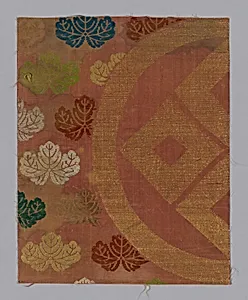
Fragment (from Noh Costume)
Edo period (1615– 1868), 1675/1725
Medium
Brocaded twill (kara ori) silk and gilt paper; 2 1/2 strips to m.m.
Dimensions
27 × 21.5 cm (10 5/8 × 8 1/2 in.)
Classification
weaving
Department
Textiles
Museum
Art Institute of Chicago
Accession Number
156232
Rights
Public Domain
Art Historical Context
This exquisite fragment hails from a Noh costume, a hallmark of Japan's classical theater tradition during the Edo period (1615–1868), dated roughly to 1675–1725. Noh drama, with its stylized performances blending dance, music, and poetry, emerged in the 14th century but flourished under the shogunate's patronage in Edo (modern Tokyo). Costumes like this were essential, transforming performers into ethereal spirits or warriors through bold patterns and luxurious fabrics, elevating the art form's mystical allure. Crafted in brocaded twill silk using the kara ori technique—a sophisticated discontinuous supplementary weft method—the textile weaves intricate motifs without excess threads, creating crisp, vibrant designs ideal for stage visibility. Gilt paper strips add a shimmering gold accent, mimicking metallic threads while keeping the fabric lightweight and supple. Measuring just 27 × 21.5 cm, this 2½ strips-to-the-meter sample reveals the precision of professional weavers in Kyoto's Nishijin district, where such looms produced elite textiles. Though a mere fragment, it embodies the Edo era's cultural zenith, where theater and craftsmanship intertwined to reflect samurai refinement and spiritual depth. On view in the Art Institute of Chicago's Textiles Department, it invites us to imagine its role in a moonlit Noh stage, whispering tales of Japan's enduring artistic legacy.
About the Artist
Unknown
The artist designated as "Unknown" in our virtual museum's collection exemplifies a poignant chapter in art history: creators whose identities have faded into obscurity despite the enduring power of their work. With only one known artwork attributed to them in our holdings, this figure represents countless anonymous hands that shaped visual culture across centuries. Museums worldwide, including th...