
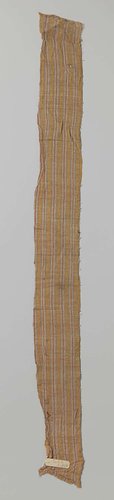
Fragment gestreept zijdeweefsel
1700 - 1799
Medium
tabby
Dimensions
0.4; 106; 10.5
Rights
Public Domain
About this artwork
width 0.4 cm
Art Historical Context
This delicate fragment of striped silk textile, titled *Fragment gestreept zijweefsel*, offers a glimpse into 18th-century weaving artistry from an anonymous craftsman. Dating between 1700 and 1799, this strip measures an impressive 106 cm in height and just 10.5 cm in width, suggesting it was once part of a larger luxury fabric, possibly for garments, furnishings, or trade goods. The fine stripes, noted in historical records as 0.4 cm wide, highlight the precision of the era's textile production. Woven in a classic tabby structure—a plain weave where warp and weft threads interlace evenly—this piece exemplifies fundamental yet sophisticated loom techniques. Tabby weave was ideal for silk, allowing vibrant stripes to emerge through alternating dyed yarns, creating visual rhythm without complex patterning. In the 18th century, such silk fragments were hallmarks of burgeoning textile industries in Europe, particularly in the Netherlands and France, where silk symbolized wealth and global trade. Though anonymous, this artifact underscores the skilled labor behind everyday opulence, preserving a tactile link to fashion and domestic life of the Enlightenment period. Visitors can appreciate how these humble remnants reveal the elegance of stripes in an age of rococo excess.
About the Artist
anonymous
In the vast tapestry of art history, "Anonymous" stands not as a singular individual but as a collective designation for countless unidentified creators whose works have endured across millennia. These artists, spanning prehistoric cave painters to medieval illuminators and folk craftsmen, produced the foundational layers of human visual culture. Prior to the Renaissance, when individual fame emer...